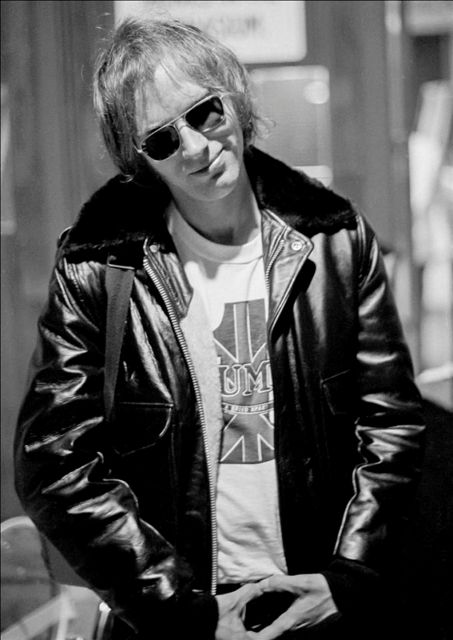
 photo: David Ramage |
SANDY PEARLMAN August 5, 1943 – July 26, 2016 Sandy calls me on the first day of winter. He's excited we're coming to San Francisco and Santa Cruz. Maybe he'll stay with us and travel up to Seattle. He has some restaurants he wants us to try, and we can't wait to play him the version of the Byrds' "8 Miles High" we've worked up. For Sandy, the Byrds are "visually perfect mythic imagery," as he writes in 1971, in The History of Los Angeles, of which only excerpts have appeared. "The Byrds swim in mystery...," he raptures, this most futuristic of the first generation of rock "critics" who will change the way popular music might be discussed and annotated in the pages of Crawdaddy!, on his way to channeling his epic poem Imaginos into the creation of ecstatic sound. He celebrates the "nostalgic technologies: magic, science and religion, sci-fi, Child ballads, hill ballads, 'serious' C&W chestnut..." Technology as transcendence. Imaginos, the cosmos of the mind's universe. Sandy's vision was always focused on what happens next. He saw the power of Heavy Metal – indeed, he named it – as a vehicle for myth, and through his instigation and guidance, Blue Oyster Cult, once Soft White Underbelly, earned their place as hard rock's foremost thinkers, no mean feat in a genre that celebrates blunt force; and carried this sensibility into his work with Pavlov's Dog, the Dictators, the Clash, and his heightened analog studio, Alpha and Omega, where the Fairchild compressor took pride of place. Yet he was never digital-phobic, seeing immediately the possibilities of song delivery and how the business of disseminating music would transform in the twenty first century. To follow the synapses of his consciousness was to rocket-ride into hyperspace. His teaching blended erudite and Aphrodite. He lectured Pearlmanology at McGill, Stanford, and the University of Toronto, and when we spoke on that December afternoon, only hours before he suffered the stroke that grounded his astral traveling, he told me that he was going to teach a spring course at Stony Brook. I asked him what his subject would be. He hadn't decided but namechecked the 19th century composer Anton Bruckner. I planned to attend, so I too might learn and be illuminated, in the same way appreciating Sandy's thought processes in Crawdaddy! inspired me to take up the qwertyuiop and begin to understand and scribe my own responses to what I listened to, and what I would become. Now I will put on the 8th Symphony, the last Bruckner completed in his lifetime, its dissonances and resolves and crescendos so like life itself, and allow Sandy to guide me through its sonorities and transfigurations, so like Sandy himself. —Lenny Kaye |


